
Shoulder Mobility Overhead: Comfortable Movement and Practice Choices
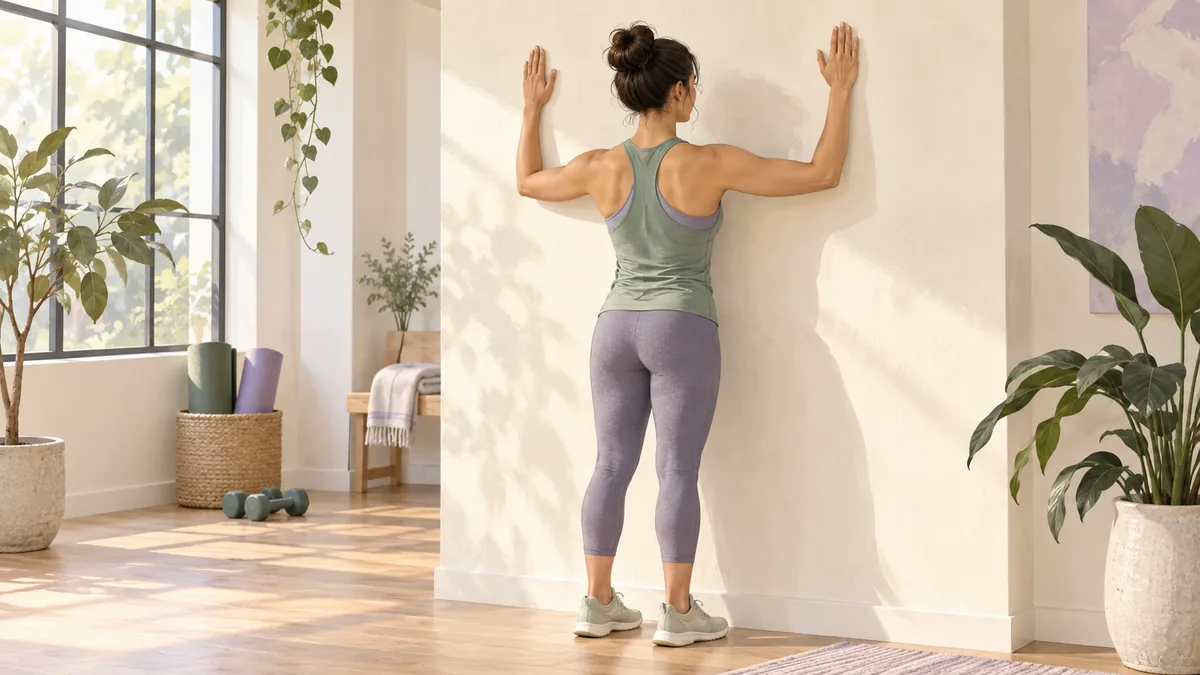
Reaching overhead involves the shoulder, shoulder blade and trunk together. If the position feels restricted, a wall observation cannot identify a tight muscle or diagnose the cause. You can still use a consistent, comfortable movement to choose a manageable practice and notice changes.
This guide offers general movement options. It is not rehabilitation for shoulder pain or clearance for hanging, handstands or bridges.
Make one repeatable observation
Stand comfortably and slowly raise the arms within a pain-free range. Notice where they stop and whether you change your torso position to reach farther. You may repeat the observation lying with knees bent, but touching the floor is not a universal standard.
Keep the stance, arm direction, and trunk position similar when comparing sessions. Do not force the lower back flat or the arms against a wall. Body proportions and technique affect the result.
If there is pain, a recent injury, instability, weakness, or symptoms affecting ordinary activity, obtain individual guidance rather than trying to stretch through the limit.
Select two or three comfortable options
Start after easy general movement. The quantities below are examples, not a six-drill prescription proven to correct overhead range.
Unloaded arm raises
Raise and lower the arms slowly, using a direction that feels comfortable. Begin with a few repetitions and stop before forcing an end position. Keep breathing rather than bracing hard to reach a mark.
Comfortable wall slide
Stand facing a wall with hands or forearms resting lightly on it. Slide upward only as far as you can control, then return. Stay close enough that you are not leaning heavily through the arms. It is fine if the arms do not reach a full overhead position.
Supported floor reach
From a comfortable kneeling position, rest the hands on the floor and shift the hips back a little. Use only a range that does not pinch the shoulders or strain the knees. An upright wall-supported reach is an alternative when floor work is unsuitable.
Gentle doorway chest stretch
Rest a forearm lightly against a fixed frame and turn a small amount until you notice mild tension across the chest. Do not force the upper arm behind the body or push into front-of-shoulder pain. This is optional, not required to “open” the shoulder before every session.
Optional supported upper-back movement
A small folded towel behind the upper back while lying may provide a comfortable reference for gentle movement. Keep the head supported. Avoid hard bench edges or forcing a large arch over a roller, especially with back or bone-health concerns.
Keep stretching and strengthening claims separate
A comfortable arm raise practises that movement. It does not prove that a passive range has become strong enough for bodyweight loading. Mayo Clinic provides general flexibility guidance, including warm-up and avoiding painful stretches; it does not establish this menu as a treatment or gymnastics readiness test.
An overhead strength task may be a separate part of a plan selected with a coach. You do not need to add prone stick lifts or force long overhead holds to complete this guide.
Decide what to repeat
| Observation | A useful next choice |
|---|---|
| The movement is comfortable and repeatable | Repeat a small amount before increasing range |
| You arch or shrug more to reach the same mark | Reduce the reach rather than chasing the mark |
| A drill pinches or hurts | Stop it and seek advice if persistent or concerning |
| You want to load the range in a handstand | Arrange separate coached preparation |
An imaginary reader notices a smoother wall slide without any increase in height. That is useful feedback. Another reaches higher only by changing the trunk position; they record the setup change rather than calling it improved shoulder range.
Connect it to your goal
Log a few observations over time, with comfortable range and symptoms rather than a promised deadline. For handstands or bridge preparation, use the relevant coaching guidance. Reaching the arms overhead alone does not show that the same position is suitable under full body weight.
Sources and further reading
These resources support the topics noted below. The practice routine and progression checkpoints are Ko Myat examples, not programs endorsed by these sources.
- Mayo Clinic: Stretching and Flexibility — Warm muscles, comfortable tension, no bouncing, and general stretching practice; not a splits prescription.
- AAOS OrthoInfo: Gymnastics Injury Prevention — Suitable equipment, spacing, coaching and spotting. Also contains youth-specific advice; not an adult progression study.
More Flexibility guides
Front Splits for Beginners: A Supported Stretching Routine
Choose supported hip and hamstring stretches, practise a controlled return, and track a comfortable range without a fixed split deadline.
· 3 min read
How to Sit in a Deep Squat: Ankle and Hip Mobility Guide
Explore supported squats and comfortable ankle movement, choose stable equipment, and track depth without treating a self-check as a diagnosis.
· 3 min read
Static vs Dynamic Stretching: When to Use Each
Compare held and moving stretches, understand active versus passive work, and choose stretching that fits the session and performance context.
· 3 min read