
Front Splits for Beginners: A Supported Stretching Routine
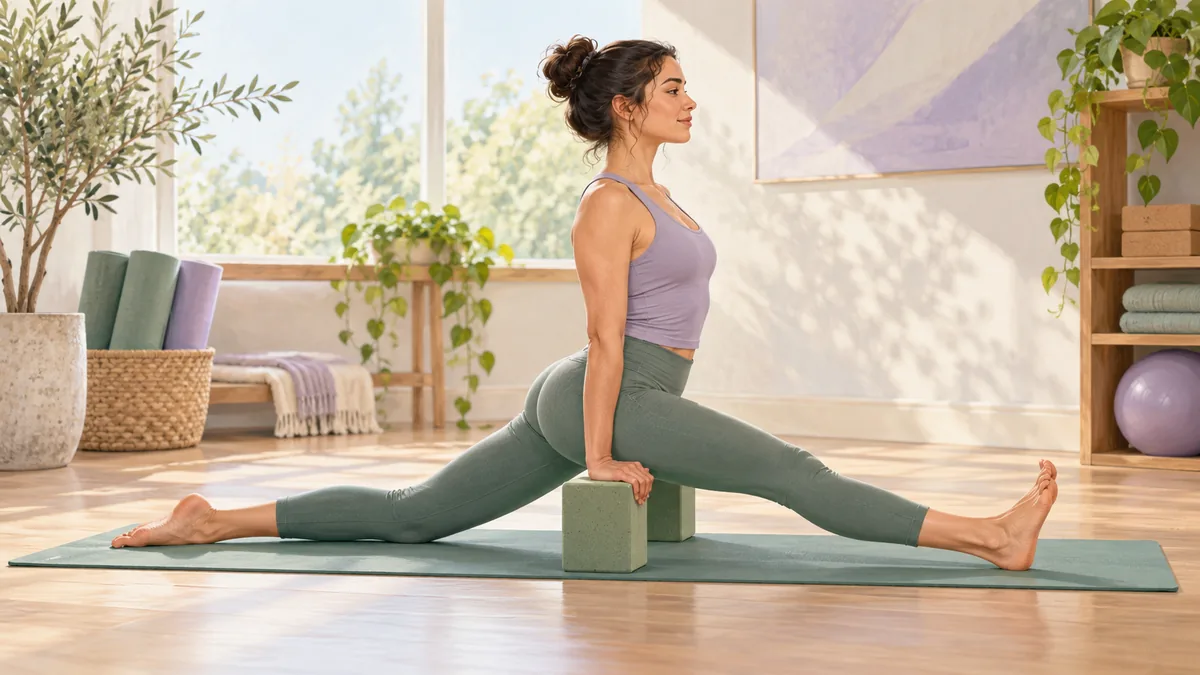
A front split places one leg forward and the other behind. You can explore the movements used in that position without sliding to the floor. A comfortable supported range is a useful goal in its own right; a full split is not guaranteed or necessary for everyday fitness.
This guide is for general flexibility practice, not pain treatment. The cover shows a supported split position farther along than many beginners will use. It is not a target depth for your first session.
Start with an exit you control
Use a non-slip surface and purpose-built stable supports. Begin in a range from which you can return without falling, dragging yourself up, or relying on a partner to lift you. Do not use slippery socks or let someone press you down.
For an injury, unexplained hip or back pain, recent surgery, or uncertainty about suitability, obtain individual advice first. Tingling, numbness, sharp pain, or joint pinching is a reason to stop rather than stretch deeper.
Warm up before choosing stretches
Spend several minutes walking or moving easily, then rehearse shallow lunges with support if needed. Mayo Clinic’s stretching guidance recommends warming muscles, using smooth movement, and avoiding painful stretching. It does not prescribe a split routine or guarantee the final position.
A supported practice menu
Choose two or three comfortable options. Start with one brief round, not every drill at maximum depth. Holds of about 15–30 seconds are an example you can shorten; time is not a reason to stay in discomfort.
Half-kneeling hip stretch
Place padding under the back knee and keep the front foot planted. Use a fixed balance support if needed. Keep the torso comfortable and shift forward only slightly until you notice mild tension at the front of the back hip. Avoid increasing range by forcing a lower-back arch.
If kneeling is uncomfortable, use a small standing split stance with support instead. Pain at the knee is not something to pad over and ignore.
Supported half split
From a comfortable kneeling position, move the hips back slightly and lengthen the front leg only as far as manageable. Keep a bend in the knee if needed. Place the hands on stable exercise blocks at a height that allows support without reaching or collapsing.
Do not pull the toes aggressively toward you to intensify the sensation. Stop if symptoms travel down the leg.
Lying hamstring stretch
Lie on your back with a strap around one foot. Raise the leg gently, keeping the knee slightly bent if that is more comfortable. The other foot can stay planted with the knee bent. Use the strap for assistance, not to force the leg toward the face.
Partial split exploration
Only with suitable coaching and supports, explore a small increase in the forward/backward leg separation. Stay high enough that your hands and legs can control the return. Do not let either foot slide away under load. This option is not required after the earlier stretches.
Pick a repeatable schedule
There is no evidence in this guide for a universal three- or four-day “sweet spot.” An initial example is a short practice on two days when you are comfortable and recovered. Adjust the amount and frequency to your response, especially if you also train legs or other demanding flexibility positions.
If soreness changes normal movement or persists, reduce the load and seek advice when appropriate. More intense stretching is not the default response to a week without visible change.
Measure the same position
Record the stretch, support height, knee bend, comfortable hold time, and symptoms afterward. Compare the same warm-up and setup. A side photo can document position, but camera angle and pelvic rotation can make a split look lower without proving a meaningful change.
For example, a reader who needs higher blocks this week can keep the same leg separation instead of forcing a lower shape. Comfortable control is a better reason to change the setup than a calendar deadline.
Keep the goal specific
Do not add the full middle-split and pancake menus to this one. Choose the goal that matters to you and leave room for recovery. A split routine also does not establish readiness for backbends or handstands.
Sources and further reading
These resources support the topics noted below. The practice routine and progression checkpoints are Ko Myat examples, not programs endorsed by these sources.
- Mayo Clinic: Stretching and Flexibility — Warm muscles, comfortable tension, no bouncing, and general stretching practice; not a splits prescription.
More Flexibility guides
How to Sit in a Deep Squat: Ankle and Hip Mobility Guide
Explore supported squats and comfortable ankle movement, choose stable equipment, and track depth without treating a self-check as a diagnosis.
· 3 min read
Static vs Dynamic Stretching: When to Use Each
Compare held and moving stretches, understand active versus passive work, and choose stretching that fits the session and performance context.
· 3 min read
Hip Mobility for Desk Workers: Short Breaks and Floor Options
Choose a brief standing movement break or a comfortable floor routine, with alternatives for kneeling and a way to track what suits your day.
· 3 min read