
How to Sit in a Deep Squat: Ankle and Hip Mobility Guide
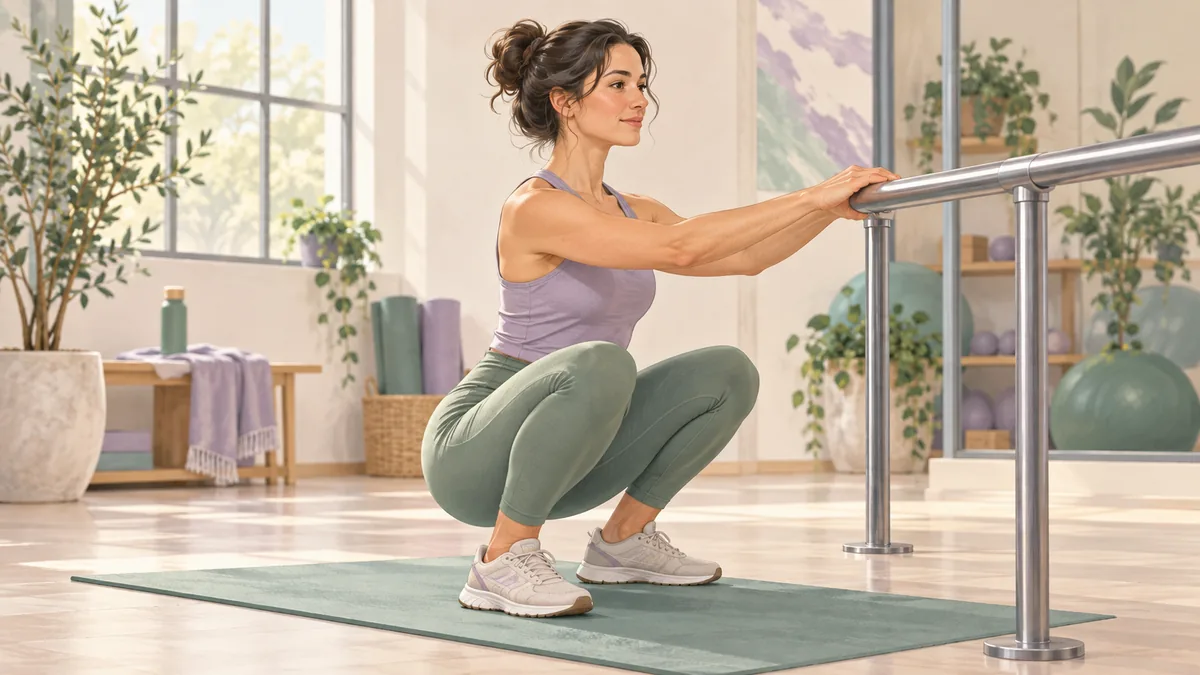
A deep squat brings the hips low while the feet support the body. Some adults find it comfortable; others need a higher target or assistance. A deep resting squat is optional, and not reaching it does not by itself mean something is wrong.
Use the observations below to choose a manageable practice. They cannot diagnose tight ankles, restricted hips, or the cause of pain.
Observe your current squat with support
After easy movement, stand near a fixed exercise rail or other suitable support that can take the force you apply. Squat only as far as you can return comfortably. Note depth, foot contact and balance without trying to force the heels down.
If you squat farther with support, balance or the way you move may contribute. If you still feel blocked, several factors may be involved. Neither result identifies a single joint or muscle as the problem.
For pain, previous hip or knee surgery, an injury or uncertainty about deep bending, obtain individual guidance before increasing range.
Use an ankle observation carefully
In a comfortable half-kneeling stance facing a wall, gently move the front knee toward the wall while keeping the heel planted. Start very close and move within a pain-free range. You can record the foot-to-wall distance using the same alignment each time.
This is a way to compare your own setup, not a universal pass/fail test or an explanation for all squat difficulty. Do not force the knee forward to meet a number. Use a standing supported ankle rock instead if kneeling is uncomfortable.
Choose one or two drills
Supported squat to a fixed target
Use a fixed exercise box or bench at a height you can sit to and rise from smoothly. Keep the support available and begin with a few repetitions. Change target height only when you retain control of the return.
Small ankle rocks
Holding a fixed support, shift a small amount forward over one planted foot, then return. Do not bounce or let the heel lift to make the recorded distance larger.
Comfortable hip shifts
On a mat with hands and knees supported, move the hips back a small amount. Adjust knee spacing to comfort rather than forcing a very wide position. Stop for pinching or knee pain.
Optional brief squat hold
If you can enter and leave comfortably, pause in a supported squat for a few seconds. A shallow hold counts. You do not have to accumulate five minutes or practise while distracted by your phone.
Mayo Clinic’s flexibility guidance supports warming up and avoiding painful, bouncing stretches. It does not show that this menu will produce a full deep squat or establish the source of a restriction.
Keep supports stable
Avoid a loose book, folded towel, or sliding plate under the heels as a balance workaround. A coach may select a purpose-built stable wedge if appropriate. Do not hold a household table that can move when you lean back, or add a weight to force yourself deeper.
Decide what to change next
| What happened | Next practice choice |
|---|---|
| You reached the target and stood smoothly | Repeat before lowering the target |
| You dropped into the last part | Raise the target and use more support |
| Your heels lifted near the bottom | Use less depth; do not force them down |
| Knee or hip pain appeared | Stop and seek advice as appropriate |
Let the knees follow the foot direction without aggressively pushing them outward. A comfortable stance can vary with your proportions; there is no single width that every reader must copy.
Compare control as well as depth
Record support, target height, stance and comfort. If a reader reaches the same height with less assistance, that is useful information even when the squat is not lower. Keep any ankle observation consistent and avoid interpreting small measurement changes as a diagnosis.
No reliable weeks-to-months prediction follows from this guide. Use a squat depth that serves your ordinary activity or training goal, including a supported single-leg progression if appropriate.
Sources and further reading
These resources support the topics noted below. The practice routine and progression checkpoints are Ko Myat examples, not programs endorsed by these sources.
- Mayo Clinic: Stretching and Flexibility — Warm muscles, comfortable tension, no bouncing, and general stretching practice; not a splits prescription.
More Flexibility guides
Front Splits for Beginners: A Supported Stretching Routine
Choose supported hip and hamstring stretches, practise a controlled return, and track a comfortable range without a fixed split deadline.
· 3 min read
Static vs Dynamic Stretching: When to Use Each
Compare held and moving stretches, understand active versus passive work, and choose stretching that fits the session and performance context.
· 3 min read
Hip Mobility for Desk Workers: Short Breaks and Floor Options
Choose a brief standing movement break or a comfortable floor routine, with alternatives for kneeling and a way to track what suits your day.
· 3 min read