
Middle Splits for Beginners: Supported Straddle Practice
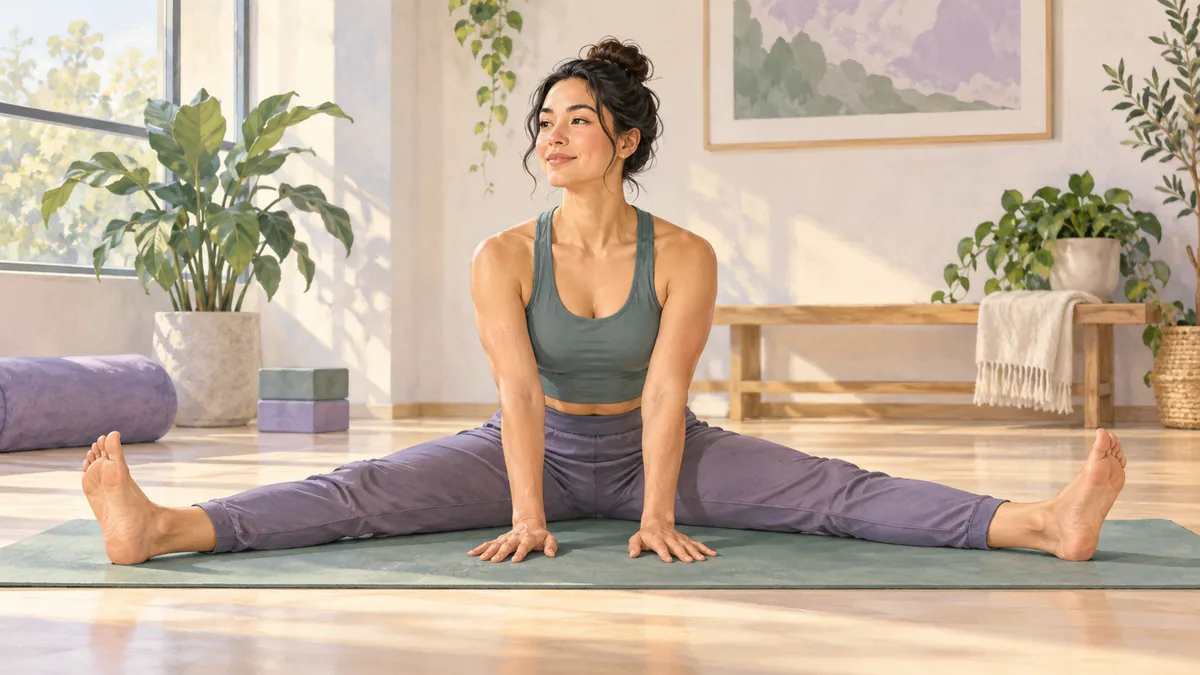
A middle split opens the legs sideways. You can practise a comfortable straddle and controlled side-to-side movement without reaching the floor. The cover shows an upright seated straddle, one preparation option rather than a completed middle split.
People differ in joint range, proportions, history, and comfort. A blocked or pinching sensation is not proof that more stretching will solve the limitation. A qualified professional can assess a concern; an online photo or self-test cannot identify hip structure.
Decide which position you can enter and leave
Choose a stable non-slip floor with room around you. Use comfortable knee padding for kneeling options. Avoid sliding the feet apart while standing: losing control can put you in a range you cannot support or exit.
If you have groin, hip or knee pain, an injury, or previous surgery affecting movement, seek individual guidance before demanding straddle work. Do not let a partner push your knees down.
Prepare with easy movement
Walk or march first, then try a few shallow side steps. Mayo Clinic advises warming up before stretching and avoiding bouncing or pain. These general principles do not establish that a full split is achievable for an individual.
Choose a small practice menu
Start with one or two comfortable options, not six deep stretches in sequence. A brief hold or a few slow repetitions can be enough to find your starting range.
Upright seated straddle
Sit with the legs separated a manageable amount. Support the hands behind you or sit on a folded blanket if it helps you remain comfortable. The knees may stay slightly bent. Keep the legs in a position that does not twist or strain the knees.
Begin narrower than you think necessary. Try a short hold, perhaps 15–30 seconds, then bring the legs back together under control. Do not use heel width as a target you must increase each session.
Gentle butterfly position
Sit with soles together and the knees resting where comfortable. Use supports under the thighs if helpful. Do not press the knees toward the floor. The aim is mild tolerable tension, not a deep groin stretch at any cost.
Supported shallow side lunge
Hold a fixed exercise rail or other suitable secured support. Step to a comfortable wide stance and shift a little toward one bent knee, then return. Keep the feet planted and let the knee follow the foot direction. You do not need to sink into a deep Cossack squat.
Optional kneeling range exploration
A coach may suggest a modest knees-apart position on padding with small hip shifts. Wide frog stretching is not necessary if it compresses the knees or pinches the hips. Choose another comfortable option rather than forcing the same drill.
Use symptoms to change the task
| What you notice | Change to consider |
|---|---|
| You lean back heavily to stay seated | Narrow the straddle or add seated support |
| You cannot bring the legs together smoothly | Reduce width and ask for assistance planning |
| The inside of a knee hurts | Stop; do not twist the foot to continue through pain |
| Hip pinching or a blocked sensation | Stop that range and obtain advice if persistent |
These observations do not diagnose a muscle or joint problem. Numbness, tingling, sharp pain, or worsening symptoms also warrant stopping and appropriate assessment.
Plan frequency and compare fairly
An example starting schedule is two short sessions separated by recovery time. Add work only when the current amount is manageable. There is no need for a fixed intensity score or a universal weekly optimum.
Record seat height, leg position, assistance and comfort. Compare the same setup after a similar warm-up. A wider foot position achieved by changing knee angle or pelvic position is a different task, not automatically progress.
If you later want a forward fold from the straddle, use the separate pancake guide. The middle split and pancake overlap in position, but one does not require reaching the other first.
Sources and further reading
These resources support the topics noted below. The practice routine and progression checkpoints are Ko Myat examples, not programs endorsed by these sources.
- Mayo Clinic: Stretching and Flexibility — Warm muscles, comfortable tension, no bouncing, and general stretching practice; not a splits prescription.
More Flexibility guides
Front Splits for Beginners: A Supported Stretching Routine
Choose supported hip and hamstring stretches, practise a controlled return, and track a comfortable range without a fixed split deadline.
· 3 min read
How to Sit in a Deep Squat: Ankle and Hip Mobility Guide
Explore supported squats and comfortable ankle movement, choose stable equipment, and track depth without treating a self-check as a diagnosis.
· 3 min read
Static vs Dynamic Stretching: When to Use Each
Compare held and moving stretches, understand active versus passive work, and choose stretching that fits the session and performance context.
· 3 min read