
Frog Stand: How to Learn Your First Arm Balance
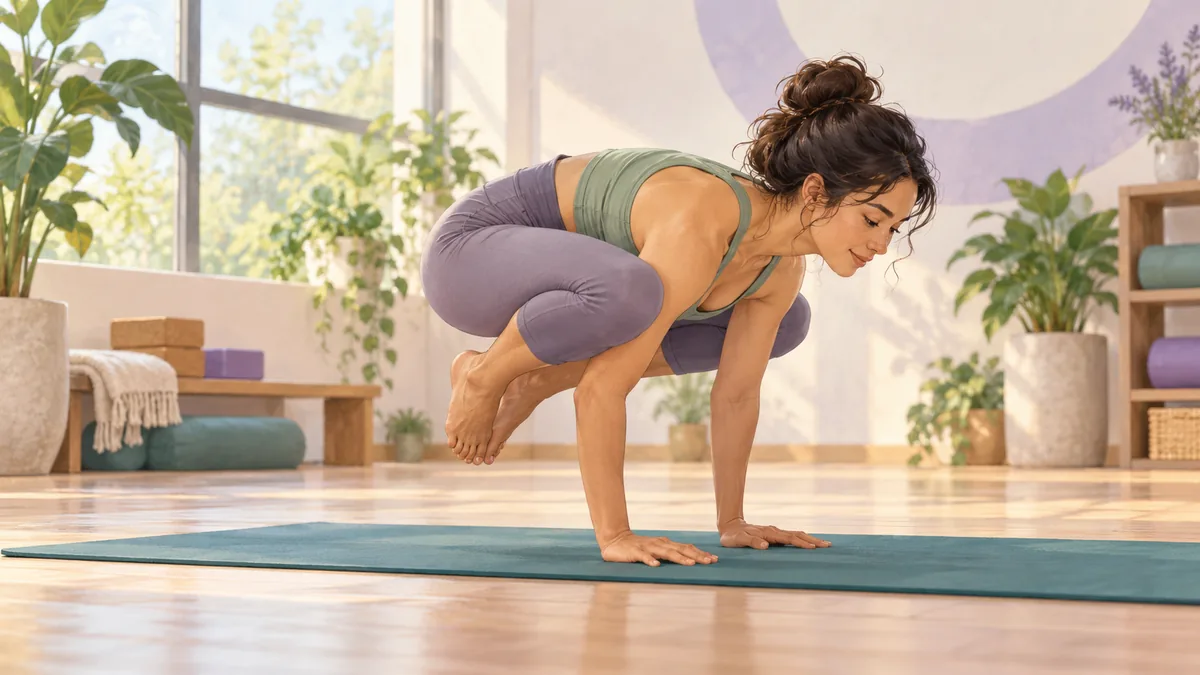
A frog stand is a low arm balance in which the knees rest against the upper arms and the feet lift from the floor. Being low does not remove the possibility of a head-first fall. Begin with supported weight shifts and qualified instruction rather than aiming immediately for a timed hold.
Names such as frog stand and crow pose are used differently across disciplines. This guide describes one bent-arm, knee-supported version; ask your instructor which shape they are teaching instead of treating the names as a universal technical distinction.
Prepare the space and the return
Use appropriate secured matting on a stable surface, with clear space around you. A loose pillow in front of your face is not a fall-protection plan. AAOS gymnastics safety advice supports appropriate equipment and coaching; it does not validate this particular arm-balance sequence.
Before both feet leave the ground, have a qualified instructor teach how to return them and assist when needed. Do not deliberately tip onto your head or neck, and do not improvise a forward roll as an exit.
Start with feet supported
After a general warm-up and comfortable wrist preparation:
- Squat at a comfortable height and place both palms on the mat in front of you.
- Spread the fingers comfortably and bend the elbows a little.
- With your instructor, position the knees against the upper arms without forcing pressure into the elbow joint.
- Shift only a small amount of weight into the hands, keeping both feet supported.
- Return the weight to the feet under control.
Hand spacing and distance from the feet depend on your proportions and the version taught. Do not force a fixed measurement from a written guide.
Explore one change at a time
A few small shifts may be enough for a first session. When the return is reliable, an instructor may introduce lifting one foot briefly while the other remains supported. Both-feet holds are another step, not an obligation after a set number of attempts.
Keep holds short enough that the return remains controlled. There is no universal thirty-second “mastery” test. If the feet rise only by suddenly pitching forward, return to the supported drill.
Finger pressure can contribute to balance, but pressing harder is not a guaranteed rescue from an uncontrolled fall. Learn that control in an assisted setting rather than testing it by deliberately overbalancing.
Read difficulties as feedback
| Observation | Useful next discussion |
|---|---|
| You cannot bring the feet back reliably | Keep feet supported and rehearse the return |
| Knees or elbows feel compressed | Check placement and whether this variation suits you |
| You hold your breath or shake increasingly | Shorten the attempt and rest |
| Wrists hurt | Stop painful loading; do not lean farther |
Fear of falling is information about the task and support needed, not proof that you should commit harder. Ask for a lower-demand drill or more assistance.
Count the load across the week
The frog stand overlaps with push-ups and handstands at the wrists and shoulders. Discuss where it fits in the overall plan rather than adding frequent sessions automatically. The wrist guide can help you record loading and next-day response.
Persistent pain, swelling, numbness, or symptoms after a fall need assessment. Purpose-built handles may alter wrist position in other exercises, but they should not be used to keep performing a painful frog stand without advice.
What progress means here
Record the amount of assistance, whether your feet returned comfortably, and any symptoms afterward. A brief controlled supported session can be progress even with no unsupported hold.
A frog stand does not establish readiness for a headstand, planche, or handstand. Those involve different demands and require their own preparation and instruction.
Sources and further reading
These resources support the topics noted below. The practice routine and progression checkpoints are Ko Myat examples, not programs endorsed by these sources.
- AAOS OrthoInfo: Gymnastics Injury Prevention — Suitable equipment, spacing, coaching and spotting. Also contains youth-specific advice; not an adult progression study.
More Gymnastics guides
Wall Handstands for Adults: Preparation, Coaching and Progression
Plan handstand preparation, learn entries and exits with a coach, and track control and workload before reducing wall support.
· 3 min read
Wrist Preparation and Load Management for Hand-Supported Exercise
Use light wrist preparation, optional manageable resistance, and a loading log for push-ups and gymnastics without treating pain as a training target.
· 3 min read
L-Sit Progression: From Tuck Sit to a Full L-Sit
Choose foot-supported holds, tuck sits and leg-extension options on stable low equipment, then adjust assistance and practice amount.
· 3 min read