
Progressive Overload Without Weights: 7 Ways to Keep Getting Stronger
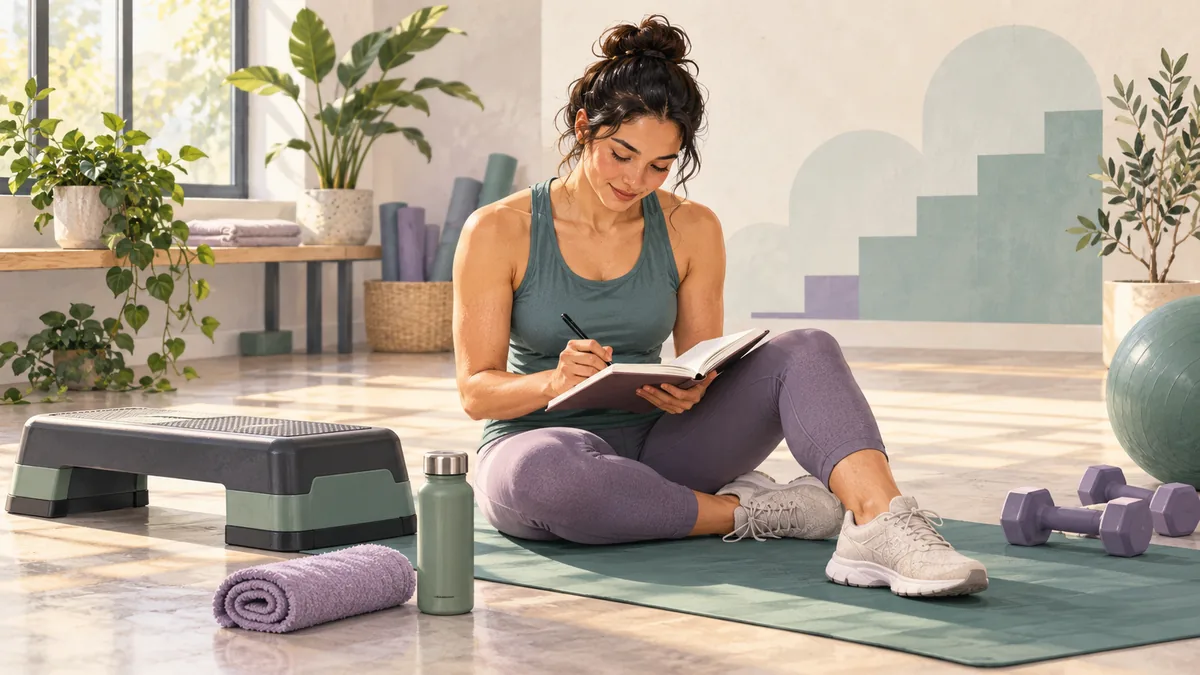
Progressive overload means increasing a training demand as your ability develops. In bodyweight exercise, you can change more than repetitions: support height, assistance, movement range, and the way you perform a repetition can all affect the challenge.
You do not need a harder session every time. Repeatable practice is useful, especially when a movement is new. ACSM’s 2026 guidance emphasizes sustainable, individualized resistance training and describes advanced methods as optional.
First make the exercise comparable
Record your setup before interpreting the numbers. Ten push-ups on a high support are not equivalent to ten on the floor. Rows change with foot position; a squat changes with target height. A vague log can make a harder exercise look like lost strength.
Use the same surface, range, and approximate rest when comparing sessions. Then choose one of these seven adjustments.
Seven ways to change the demand
1. Add a repetition
If a set remains controlled and recovery is manageable, add a repetition to one set. A range such as 6–10 can organize practice, but there is no universal repetition count at which strength training suddenly becomes only endurance.
2. Add a set
Another set increases total work and session time. Consider it only when the current amount is manageable. More sets are not automatically the answer to a plateau, and this guide does not prescribe a universal per-session set ceiling.
3. Slow a portion of the movement
A deliberate descent can help you practise control. Record it, for example “about three seconds lowering.” Slower is not inherently better for every strength goal. Extra lowering work can also produce unfamiliar soreness.
4. Add a brief pause
Pause in a position you can support, such as partway through an incline push-up. Do not pause at a painful or unstable end range. Start with fewer repetitions if this makes the set substantially harder.
5. Change the lever or support height
A slightly lower push-up support, more horizontal row, or longer hollow-hold position can change the challenge without adding equipment. The size of the jump varies, so test a few controlled repetitions rather than carrying over the old repetition total.
6. Shift more work to one side
A supported split squat or single-leg bridge offers a different loading pattern. It is not simply the same movement with double the difficulty. Keep stable supports and reduce the amount while learning coordination. Unstable equipment is unnecessary for this step.
7. Expand a comfortable movement range
You might gradually squat toward a lower fixed box or use more controlled elbow bend in an incline push-up. Do not force depth or improvise stacked blocks to create an extreme range. The extra range should remain manageable throughout the repetition.
Decide which variable to change
| Your current problem | Consider first |
|---|---|
| The setup varies every session | Standardize and record it |
| The exercise is comfortable but not challenging | Add a small number of repetitions or slightly change leverage |
| The next variation is too large a jump | Keep the current one or find an intermediate stable setup |
| Performance is falling and fatigue is rising | Reduce demands and review recovery |
| The movement hurts | Stop painful loading and seek suitable advice |
Read a log without inventing progress
These are hypothetical entries, not a tested program:
| Session | Push-up setup | Work recorded | Decision |
|---|---|---|---|
| A | Fixed high bench | 8, 8 | Repeat setup |
| B | Same bench | 9, 8, controlled | Repeat before changing height |
| C | Lower fixed bench | 4, technique deteriorating | Return to higher bench |
Session C is not proof that strength declined. The task changed. Repeating the higher version is more informative than changing height, tempo, and sets together.
When doing less is the next step
Poor performance may relate to the setup, recovery, illness, stress, or other factors. A log cannot diagnose the cause. Review rest days and reduce workload when appropriate. Persistent fatigue or pain deserves assessment rather than endless program adjustments.
Use the beginner workout to organize the week and the Start Here log to record it. The aim is a repeatable decision process, not a promise of continual gains.
Sources and further reading
These resources support the topics noted below. The practice routine and progression checkpoints are Ko Myat examples, not programs endorsed by these sources.
- ACSM: 2026 Resistance Training Guidelines — Healthy-adult resistance training, individualization, and home-based options; not a gymnastics protocol.
- Mayo Clinic: Strength Training — General resistance selection and recovery guidance; not validation of skill checkpoints.
More Fitness guides
Beginner Bodyweight Workout: An Adjustable Home Strength Plan
Start a bodyweight strength routine with manageable sets, easier variations, equipment checks, and a log that helps you decide when to progress.
· 3 min read

How Many Rest Days Do You Need? A Practical Guide to Recovery
How to plan rest days for bodyweight, gymnastics, and flexibility training, what active recovery looks like, and the warning signs that you need more rest.
· 3 min read

Muscle Soreness After a Workout: Should You Train Through It?
Understand delayed soreness, recognize symptoms that need medical care, and adjust activity without treating an online checklist as a diagnosis.
· 3 min read